When Bulgaria adopted the euro on 1 January 2026, expectations about the effect on business were quite contradictory. Does the change affect your business positively or negatively? This is a question that few entrepreneurs can answer categorically.
The introduction of the euro placed Bulgarian business in a more competitive, more comparable and more transparent European environment. This period, however, also coincided with global geopolitical upheavals, such as the war in the Middle East and the drastic rise in fuel prices, which affected every sector of business like an avalanche. And they generated substantial inflation.
Why do 100 euros today feel like less than 100 leva? And is our business model ready to be competitive in euros?
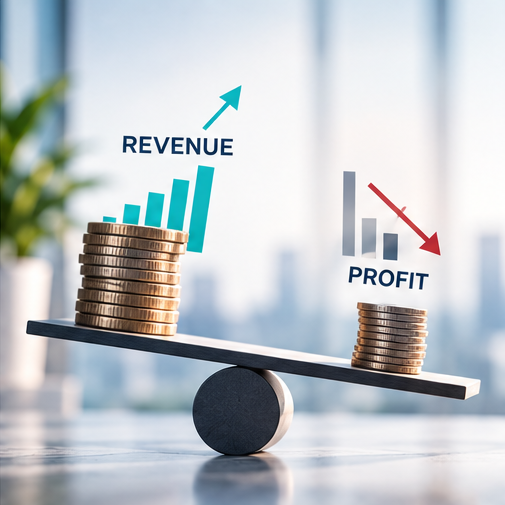
The new reality: revenue may grow while profit may fall
The European Commission expects inflation in Bulgaria to reach 4.2% in 2026, and identifies high fuel prices and a potential shortage of electricity in the region, because of the limited capacity of the nuclear power plants, as the main driver of the price rises. At the same time, the labour market remains strained and hard to predict, and in 2025 nominal labour costs per unit of output rose by 9.4%. Wage growth continues to outpace productivity growth in 2026 as well.
This creates one of the most critical situations in business. Profit is growing, while the margin is gradually disappearing.
How can a business survive in this environment? How can it stay in profit?
If you simply increase revenue today, that is not enough. Today's economic environment requires precise management of wages, productivity, people, costs and working capital. Every business decision must be taken in an informed way, and with a clear answer to the question of what lies ahead.
And is your business ready for the consequences of the new economic reality?
Not the euro, but the new economic reality, affects different industries differently.
 Manufacturing and its production cost are the main elements that worry the owners of plants and factories.
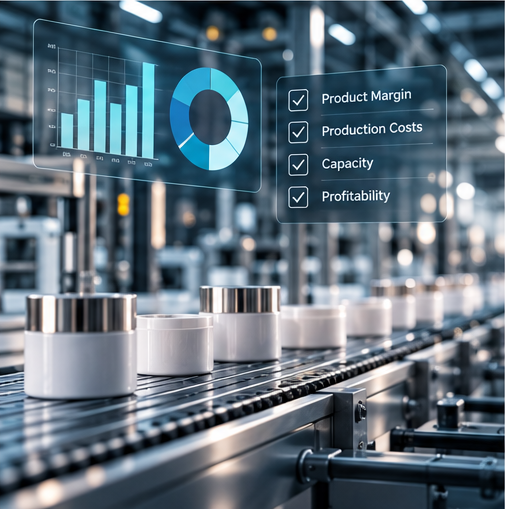
Energy, fuels, raw materials, logistics and labour can rise significantly faster than selling prices. If a company has no reliable information on the real production cost of a product, a customer or a production line, it can increase its turnover and at the same time lose profitability.
In this situation, managers need to know not simply how much they sell, but what they actually earn from. An analysis of profit before fixed costs, production capacity, an assessment of products by margin, and KPIs for efficiency and profitability is vitally necessary.
In trade, the euro makes prices more transparent and more comparable, but it also increases the pressure on the margin. Companies therefore need to analyse not only turnover, but also profitability by product, category and country.
This calls for an analysis not only of ROAS, but also of the margin, the cost of transport to the end customer, bank fees, and final profits after marketing and commissions. When did you last review and optimise your costs as a whole?

The services sector is among the hardest hit, because of the excessively rapid increase in the minimum wage, by 12.6% for 2026 compared with 2025. And if we look at a longer period, for example 5 years, we are already talking about an increase of 86.62%.
Has labour productivity in your company risen by 86.62%? How many AI solutions have you introduced, and did that help your business? Questions that only an in-depth financial analysis can answer.
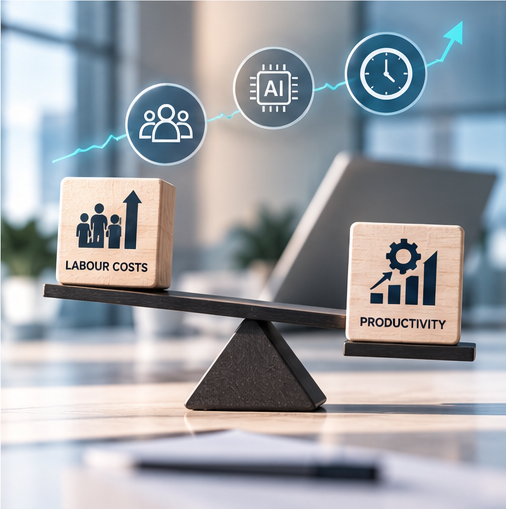
Many companies in Bulgaria could afford, before 2020, to hire more employees, because wages were lower than in Western Europe, and to neglect the demand for higher productivity. Today, however, in the eurozone, Bulgarian business is making one of the most expensive mistakes – hiring the right person for the wrong job.
A highly qualified specialist who spends a significant part of their time on administrative or repetitive tasks is an expensive resource, used at the wrong level.
The reverse is just as expensive – an employee without the necessary experience taking decisions that require professional expertise.
Organisations therefore need the right answer to three questions:
Is the right person doing this job?
Is the position at the right level?
Do we need 40 hours a week for this function?
Sometimes a business does not need a full-time Financial Director. It needs 15–20 hours of quality financial management a month and well-structured accounting and control beneath that.
Long-term projects in construction and, more broadly, in project business are exposed to serious risk, because the costs of materials, fuels, labour and subcontractors make control of project profitability critical.
Budgets, cash flows and analyses of funds actually spent against the budget must be monitored strictly, not only at company level but also at project level.
International business and exports gained the most positives from the introduction of the euro – eliminated currency-conversion costs, more accessible European financing, deals that are easier for European investors to compare, and potential new partnerships with banks, customers and suppliers.
But easier access also means more direct competition with the other European companies, and Bulgarian business must be prepared for it.
Ordinary accounting firms report the past of your business. We will help you manage its future.
The big opportunity is not the conversion to the euro. It is optimisation.
We changed the currency, but that is simply a technical process.
The real opportunities for business are revealed if we manage to adapt faster and create sustainable competitive advantages based on information and a detailed knowledge of our own business.
The real opportunity is to use the moment to ask the harder questions:
Where are we losing money?
What are we earning from?
Where can we use artificial intelligence?
What can we automate?
How much revenue does one employee generate?
How much does one order cost us?
How much capital have we locked in the warehouse?
Can we afford a new wage increase of 13%?
And if fuels and energy become 10% more expensive?
These are questions that your accounting cannot answer.
This is financial management.
Not sure which products, customers or processes are eating your margin? Let us find out together.
Request a free initial consultation and analysis
1. Optimise costs – with clearly drawn scenarios
The most important thing in conditions of high inflation is to optimise costs, but that does not mean simply reducing them.
Sometimes the cheapest supplier costs the most. Sometimes an additional employee increases the productivity of the whole team. And sometimes a position the company has grown used to treating as necessary can now be automated.
Every significant cost should therefore be examined through the question:
What value does it create?
2. Hire the right employees, not the highest level
You do not need a financial director if their duty will be to process invoices.
Nor do you need an accountant who will draw up the financial strategy.
You do not need a senior specialist for work that can be automated.
And not every function requires a full-time employee.
The right person. The right task. The right level. The right working hours.
This substantial change in your organisation can substantially improve your cost structure and your profit.
3. Implement AI where it can free your valuable people for more valuable work.
AI is not simply a strategy.
Everyone talks about AI, but for the most part there is no clear vision of when it is used.
Artificial intelligence is needed when it solves a specific problem or automates a specific piece of work.
AI is already an indispensable assistant in processing documents and analysing large sets of data, and it gives us the chance to be better informed when the important decisions are made.
The goal is not the technology.
The goal is less time processing information and more time making decisions.
4. Why data is a management tool
Many companies have a huge amount of data in their ERP, accounting software, CRM, e-commerce platform and Excel.
But they lack one simple answer:
What should I do with this data, and how can it be useful for the future of my business?
Every manager nowadays must have not simply a beautiful reporting dashboard, but the clear vision of what it is telling them.
Sales → Margin → EBITDA → Cash Flow
and allow analysis by companies, markets, products, customers and channels.
Managers now need real-time reports, rather than waiting until the end of the month, or even the end of the year, to get the information.
And it does not matter whether your business is small or large. The right information today guarantees a secure financial future.
5. Manage the future through scenarios
In an environment of inflation and rising costs, one budget is no longer enough.
Companies must model different scenarios:
What happens at +5%, +10% or +15% labour cost?
What happens with a new increase in electricity or fuels?
How much can we raise prices without losing volume?
How much working capital will we need at 20% growth?
At what profit can we afford to hire a new person?
In this way the financial model turns from a report on the past into a tool for managing the future.
The euro does not change only the currency. It raises the standard.
Bulgarian companies now work in one currency with a large part of their European competitors.
This means fewer currency barriers, easier cross-border operations and potentially better access to financing.
But it also means something else:
inefficiency becomes more visible.
Bulgarian companies can no longer compete with lower wage levels than their European competitors. They should create an environment in which the competitive advantage will be higher value, higher productivity from every person.
The model is clear: use the generated accounting information
Use AI and every piece of available information about your business to create a sustainable future through scenarios. So that you are more competitive and more effective.
At Space2F we believe that the finance function should not simply report the business.
It must make it better.
That is why we combine:
Accounting, Taxes, Payroll, CFO as a Service, ERP implementation and various automations, Analysis and Corporate finance
to help companies move from:
data → information → decision → result.
We can analyse the financial and operational model of your company, identify where margin, time and resource are lost, and build a structure for better efficiency, control and growth.
The euro is already here. Fuel keeps getting more expensive. The labour market is becoming ever more strained.
The question is: is your business ready for the next level?
Space2F — Where Finance Inspires the Future.